
In the year AD 1330, a priest in Siena was asked to administer the Holy Eucharist to a dying sick man in his town. He agreed to this request but irreverently placed the Consecrated Host between the pages of his breviary instead of placing it in a Pyx and carrying it close to his heart. When he arrived at the sick man’s house and opened the breviary to give him the Communion, he found that the Host was bleeding and there were round stains of blood on the two pages of the breviary where it was placed.
He immediately repented for what he had done and rushed to the nearby Augustinian monastery in Siena to confess and narrate what had happened to Blessed Fr. Simon Fidati who was a well known holy man. He granted absolution to the truly repentant priest and took the two pages and placed one in a tabernacle in Perugia and the other he bought to the Augustinian monastery of Cascia in Italy and placed it in a reliquary.
The pages were preserved and numerous tests were performed. In 1389, Pope Boniface IX confirmed the authenticity of the miracle.
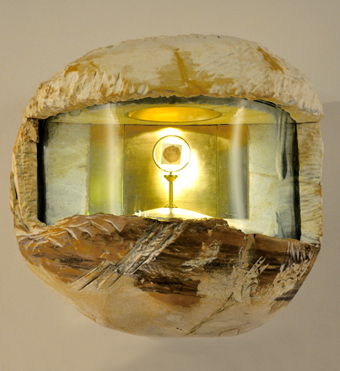
Over the years, a secondary miracle too has been observed on the paper. The blood stains have formed the outline of a human face. Both pages now show the face of a man with a beard. To this day, the stains of the Precious Blood can be seen on the pages of the breviary which are preserved in the lower chapel of the Basilica of St. Rita in Cascia, Italy. The fragment of parchment paper measures 52 x 44 mm and is kept in a stone and crystal tabernacle, flanked by two marble panels depicting the two sides of an open book.
The relic of the Eucharistic Miracle has been venerated by the faithful for centuries now. Various Popes promoted its veneration with special indulgences, including that of Portiuncula by Pope Boniface IX in 1401. This miraculous event is also commemorated every year on the feast of Corpus Christi, when the relic is carried solemnly in procession.